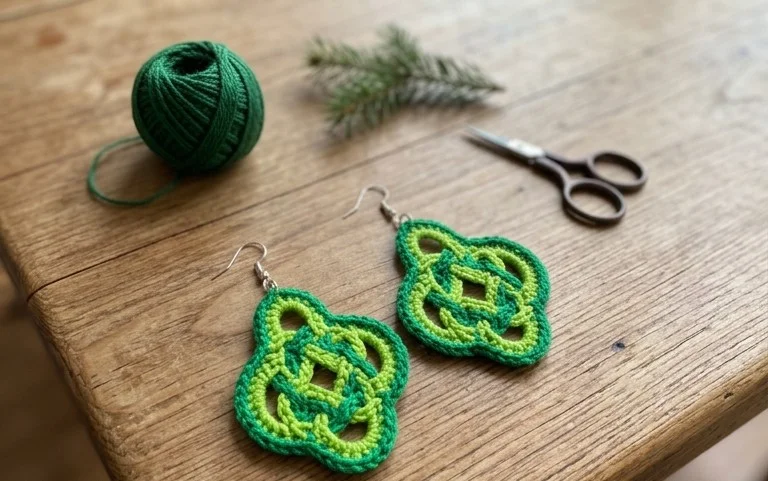
Celtic Christmas Crochet Earrings: Free Easy Pattern
These dainty accessories bring a festive spirit to any holiday outfit with their unique knotting and rich, seasonal colors. They sit lightly on the ears, providing a subtle sparkle that catches the light during dinner parties or gift exchanges. If you enjoy small projects that reward your patience with a sophisticated outcome, these earrings are a joy to work on between holiday errands. You will become familiar with the specific joining technique needed to mimic ancient stone carvings while using simple loops. This project relies on thread control to ensure your knots remain tight and crisp against the ear hook.
Why You’ll Love This Pattern
This classic crochet dishcloth works up quickly using simple, sturdy stitches that scrub away grime effectively. Cotton yarn provides the necessary absorbency for kitchen cleanup, while the textured surface helps exfoliate or scour surfaces better than smooth fabrics. Because the pattern relies on a repetitive base stitch, it is an ideal project for practicing consistent tension while watching television or listening to an audiobook. You can complete an entire cloth in under an hour, making it an excellent choice for a last-minute handmade gift.
I managed to whip up a set of three of these for my sister in just one weekend and the texture is exactly what I was looking for to replace my old synthetic sponges.
— Sarah, home crafter
Pattern Overview & Skill Level
- Skill Level: Beginner
- Approximate Time: 45 to 60 minutes
- Construction: Flat panel worked in rows
- Finished Dimensions: 8 inches by 8 inches
Materials & Supplies Needed
- Yarn: Worsted weight (#4) 100% cotton yarn, approximately 60 yards per cloth.
- Hook Size: 5.0 mm (US H-8).
- Notions: Tapestry needle for weaving in ends, sharp scissors.
- Yarn Substitutions: You may use a cotton-linen blend for increased durability, though 100% cotton offers the best absorbency. Avoid acrylic yarns as they are not absorbent and will melt if they touch hot cookware.
Stitch Guide & Abbreviations (US Terms)
- ch: chain
- st/sts: stitch/stitches
- sc: single crochet (insert hook, yarn over, pull up a loop, yarn over, pull through both loops on hook)
- dc: double crochet (yarn over, insert hook, yarn over, pull up a loop, yarn over, pull through two loops, yarn over, pull through remaining two loops)
- sl st: slip stitch
- sk: skip
Step-by-Step Pattern Instructions
Main Body
The cloth is worked back and forth in rows. The turning chain does not count as a stitch.
- Row 1: Ch 26. Sc in second ch from hook and in each ch across. (25 sts)
- Row 2: Ch 1, turn. 1 sc in next st, 1 dc in next st. Repeat from * to * until 1 st remains. 1 sc in last st. (25 sts)
- Row 3: Ch 2, turn. 1 dc in next st, 1 sc in next st. Repeat from * to * until 1 st remains. 1 dc in last st. (25 sts)
- Rows 4 through 24: Repeat Rows 2 and 3.
Finishing
Do not fasten off after Row 24. Work one round of sc evenly around the perimeter of the square to create a clean, finished border. Place 3 sc into each corner to prevent the edges from curling. Join with a sl st to the first sc, fasten off, and weave in all yarn tails securely using a tapestry needle.
Care & Washing Instructions
- Machine wash your cotton dishcloths in warm water on a gentle cycle.
- Tumble dry on low heat or lay flat on a drying rack to maintain the shape.
- Avoid using fabric softener, as it leaves a residue that reduces the natural absorbency of the cotton fibers.
Pro Tips & Common Mistakes to Avoid
- Maintain consistent tension throughout the project to ensure the square remains flat; pulling too tightly on the double crochet stitches will cause the cloth to shrink inward.
- Use a stitch marker in the first stitch of every row if you find yourself accidentally skipping the final stitch, which causes the edges to pull into a triangle shape.
- Weave your ends back and forth in multiple directions through the stitches rather than simply knotting them, as knots will come undone after repeated washings.
- You can adjust the size by chaining an odd number of stitches for your foundation row; keep in mind that a larger cloth will require more than the recommended 60 yards of yarn.
Frequently Asked Questions
Can I use a different yarn weight for this pattern?
Using a different yarn weight will significantly change the size and density of the finished item. If you use a lighter weight yarn, you will need to increase your starting chain length to reach the desired 8-inch width.
Why are the edges of my cloth looking uneven?
Uneven edges usually result from missing the first or last stitch of a row. Always count your stitches at the end of each row to ensure you have exactly 25 stitches before turning.
Is it okay to sell items made from this pattern?
You are welcome to sell finished items created from this pattern. I ask that you provide credit to the designer by linking back to this tutorial on your product listings.
How do I prevent the dishcloth from smelling musty?
Always wring the cloth out thoroughly after use and hang it over a sink divider or drying rack so air can circulate on both sides. Washing them once a week with a cup of white vinegar helps keep them fresh.
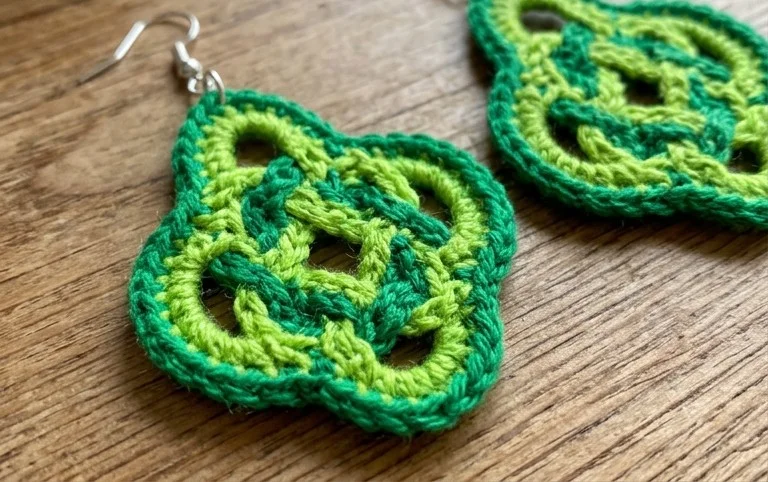
Your finished pieces possess a charming, lightweight quality that makes them a favorite for seasonal celebrations. You might swap the traditional red or green cotton thread for a metallic gold or silver version to add a modern glimmer to your jewelry collection. Sharing your finished photos helps others find their next project, so tag your images on social media to spread the holiday cheer. Browse the rest of the blog for additional accessory patterns that rely on similar construction methods and basic thread work.